


When the United States and Germany Had Our Own October 7 Attacks
Written by Richard Solomon
The Dakota Uprising of 1862 and the Herero Genocide of 1904-08 provide a striking parallel to October 7 and the genocide in Gaza.
How should we place October 7th in comparative terms? October 7, 2026 marked the third anniversary of the Al-Aqsa Flood attack by Hamas and allied Palestinian guerrillas and the Gaza Genocide. Democratic socialists who wish to make sense of these events may place them within global history. To that end, we should consider how closely October 7 resembles the Dakota Uprising of 1862 in present-day Minnesota and the Herero Genocide of 1904-1908 in present-day Namibia. In all three cases, a long history of settler abuses, ethnic cleansing, and starvation culminates in a native attack on the settlers, hundreds of whom are killed. The natives are divided, but ultimately a militant flank prevails—Dakota chief Little Crow, Herero leader Samuel Maharero, and Al-Qassam Brigade commanders Yahya Sinwar and Mohammed Deif take the lead.
Driven by desperation and revenge, native fighters under these leaders temporarily exile thousands of white settlers from formerly native lands and take hundreds captive. But whether in Gaza, Namibia, or the Minnesota River valley, retaliation by the more powerful settler state far exceeds the natives in its violence and organization; Minnesota Governor Alexander Ramsey demands the natives “be exterminated or driven forever beyond the borders of the State”; German military commander Lothar von Trotha issues a proclamation that “Any Herero found inside the German frontier, with or without a gun or cattle, will be executed. I shall spare neither women nor children.” Israeli Prime Minister Netanyahu calls on Israeli troops to treat the Palestinians in Gazan like the Amalekites of the Hebrew Bible—to “put to death every man, woman, child, and infant”(1 Samuel 15:3) and “blot out their memory” (Deuteronomy 25:19).
Whether in Minnesota, Namibia, or Gaza, these statements do not presage as much as describe what settler forces were already doing. The settlers carry out mass executions and intern the natives in concentrated, enclosed areas—Fort Snelling in Minnesota, Shark Island in Namibia, and Al-Mawasi in Gaza. Even native groups that had friendlier relations with the settlers or who sheltered settler civilians from capture are driven by the occupying army into exile, their homes destroyed. Disease and starvation ravage the interned native population. In the settlers’ metropole, there are appeals for mercy, but the frontier war continues. German Socialist leader August Bebel for example gives a speech on the floor of parliament condemning the “barbaric methods of war” by General Trotha and the German army, who are starving the Herero to death in the desert. As the Episcopal bishop in Minnesota described of the U.S. response to the Dakota uprising, “Our country must forever bear the disgrace and suffer the retribution of its wrongdoing. Our children’s children will tell the sad story in hushed tones and wonder how their fathers dared so to trample on justice and trifle with God.”
It is worth giving a brief synopsis of each case before concluding with their differences.
Dakota Uprising of 1862
The basic details of the Dakota rising are by now well-known and can be referenced in Michael Clodfelter’s book The Dakota War: The United States Army Versus the Sioux, 1862-1865 (1998), Mary Lethert Wingerd’s North Country: The Making of Minnesota (2010) and Gary Clayton Anderson’s Massacre in Minnesota: The Dakota War of 1862, the Most Violent Ethnic Conflict in American History (2019). Eastern Dakota tribes had lost vast territory to the United States in a set of treaties (1837, 1851, 1858), which they were coerced into signing in exchange for annual cash transfers and food that the federal government promised to deliver. They accepted these treaties even as the U.S. Senate derecognized the treaty articles that were supposed to protect Dakota reservation lands against settler encroachment. Minnesota in the 1850s also saw the rapid rise of the white settler population from around 6,000 individuals in 1850 to 172,000 in 1860. The settlers’ intensive land use and hunting practices had decimated wild game populations that Dakota bands had traditionally relied on for subsistence and fur trading.
A corrupt system of Indian ‘agents’ and traders had further exploited the indigenous peoples, and many Dakota grievances centered on the traders’ greed, theft, and fraud. The purchase of Native women in particular aroused deep resentment. Some settlers like the trader Andrew Myrick purchased multiple wives, who served them as little more than sex slaves. As one tribal elder Big Eagle recalled, “white men abused the Indian women in a certain way and disgraced them.” By the summer of 1862, the federal government was late on its annuity payments for the second year, and rumors of its bankruptcy due to the U.S. Civil War had spread.
The specter of starvation became increasingly real for the Dakota; the 1861 crop failure had been crippling, and traders became increasingly unwilling to give the Dakota food on loan, fearing the annuity payments would not arrive. The trader Andrew Myrick said “So far as I am concerned, if they are hungry, let them eat grass or their own dung.” The Dakota Mdewakanton leader Little Crow quoted this line in a letter to the U.S. military commander Henry Hastings Sibley explaining the major reasons for the Dakota war: “we made a treaty with the Government, a big [concession] for what little we do get and then [we] can’t get it till our children was dying with hunger.”
On August 4, 1862, some eight hundred Dakota broke into a warehouse to seize sacks of flour, narrowly avoiding a gun fight with state militias. On August 17, four half-starved Dakota men killed five settlers including a wife and daughter. Stories differ about the proximate reason for the murder—one version involves an argument about them stealing eggs from a hen’s nest along the fence line of the homestead, another about the farmer refusing them water and food. In either case, the anticipated retaliation forced Dakota chief Little Crow into a bind; although he and other leaders like Wabasha, Wacouta, and Big Eagle were initially against the uprising, “the whites would take a dreadful vengeance” (in Big Eagle’s words) against the Dakota for the slain women, and so the tribe, pushed by its youth, opted to start the war first. As Big Eagle recalled, the cry became “Kill the whites and kill all these cut-hairs who will not join us.”
The next day, the uprising started with an attack on the Lower Sioux Agency, with the goal of driving out all settlers from the upper Minnesota River valley. It lasted 5 weeks. The first day, the abusive trader Myrick was killed by a brother of the Dakota woman he had purchased, Myrick’s mouth stuffed with grass in a pointed reference to the grass he had mockingly told the starving Dakota to eat. Over the next five weeks, Dakota men killed 358 civilian settlers, 77 soldiers, and 36 volunteer militia members. White settlements were burned to the ground. Hundreds of white and ‘mixed blood’ hostages, mostly women and children, were taken captive. At least 33,000 settlers and biracial civilians fled the violence, some sheltered by non-hostile Dakota. Dozens of Minnesota counties were depopulated. A stenograph gives a photo of the evacuees (below). Although known as the ‘Dakota War’ the historian Mary Wingerd clarifies that it was waged almost exclusively by the Mdewakanton tribal faction among the Dakota; fewer than 1,000 of the 7,000 Dakota joined the fighting, and many tribal elders (including Little Crow himself) opposed the war as suicidal. Retaliation by whites fed the violence and encouraged a sense of nihilism. As the leader Hda Inyan Ka said in a speech to continue the war:
“Some of our people have been shot, some hung; others placed upon floating ice and drowned; and many have been starved in their prisons. It was not the intention of the nation to kill any of the whites until after the four men returned from Acton and told what they had done. When they did this, all the young men became excited, and commenced the massacre. The older ones would have prevented it if they could, but since the treaties they have lost all their influence. We may regret what has happened but the matter has gone too far to be remedied. We have got to die. Let us, then, kill as many of the whites as possible, and let the prisoners die with us.”
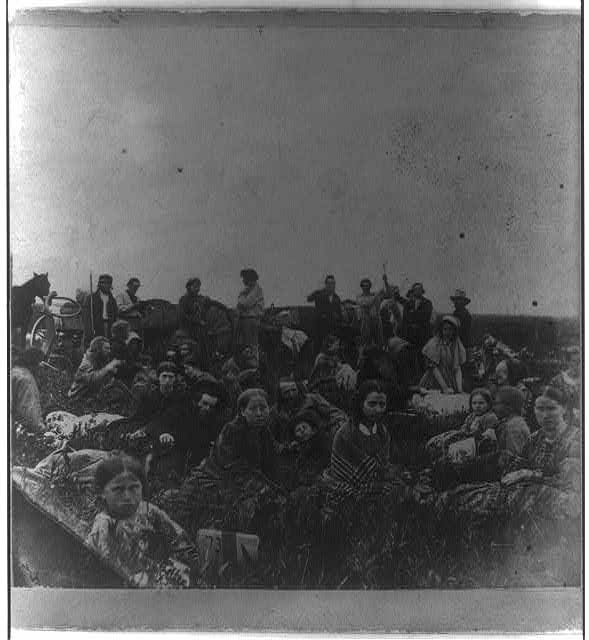
The United States’ response was initially delayed by the fact that army contingents were pinned down by the Civil War further south, but once the reinforcements arrived, their violence far exceeded the Dakota in ferocity and bluntness. As mentioned above, the Minnesota governor Alexander Ramsey called for the Dakota to “be exterminated or driven forever beyond the borders of the State.” Lieutenant Governor Ignatius Donnelly and many settler newspapers concurred. Congress nullified treaties with the Dakota and abolished reservations. The 2,000 Dakota who surrendered were marched 150 miles away and interned in a concentration camp at Fort Snelling called Pike Island (pictured below). The vast majority (at least 1,658) were civilians. Around 10% of the interned population died there that winter of 1862-1863, many of measles and pneumonia. In April 1863, Congress passed a law to drive all Sioux (Dakota and Lakota) from Minnesota to reservations further west. Hundreds more died on the journey. Even Dakota such as Snana (Maggie Brass) who had opposed the war, protected whites, or helped free the white hostages were interned and exiled. As general John Pope said,
“It is my purpose utterly to exterminate the Sioux if I have the power to do so, and even if it requires a campaign lasting the whole of next year. Destroy everything belonging to them and force them out to the plains, unless as I suggest, you can capture them. They are to be treated as maniacs or wild beasts, and by no means as people with whom treaties or compromise can be made.”
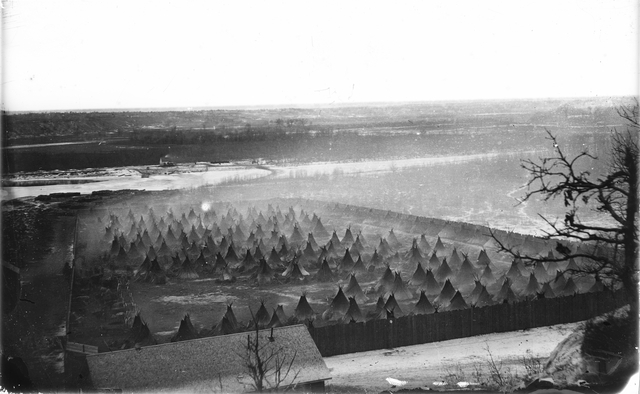
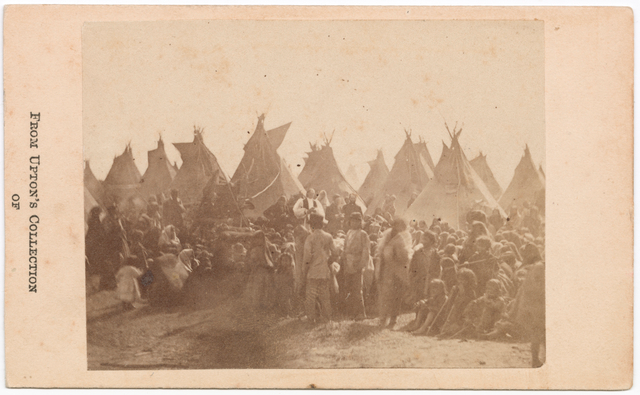
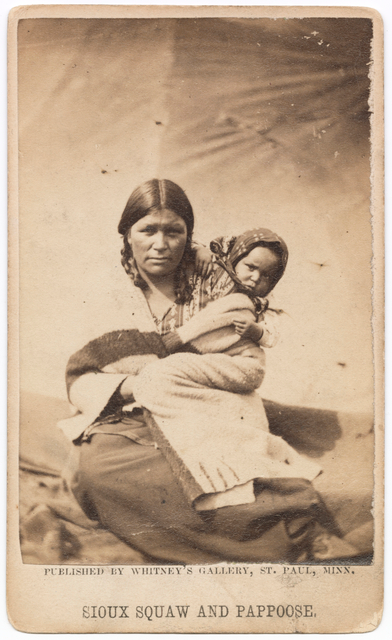
Dakota woman and child at Pike Island, 1862-63. Source: Minnesota Historical Society
In addition to the 150 Dakota killed in the fighting, the U.S. military condemned an additional 303 captured Dakota men to death. After pleas for mercy by the Episcopal bishop Henry Benjamin Whipple, U.S. president Abraham Lincoln commuted many of the death sentences but allowed 39 to be executed. The hanging of 38 of them on December 26, 1862 at Mankato marked the largest mass execution in U.S. history. Four thousand spectators came to watch. White retribution was aided by what the historian Gary Clayton Anderson describes as lurid but difficult-to-substantiate atrocity propaganda, such as the prevalent belief that white women had been systematically raped. Anderson could only verify two named instances of possible sexual abuse of white women—Mattie Williams and Mary Schwandt—against the apoplectic reports of widespread rape in newspapers of the time. Yet potent allegations of rape, regardless of their veracity, had a function. In the patriarchal frontier culture of the 1860s, rape was a spoil of war, a means to emasculate the enemy’s mensfolk, and a threat to compel their communities to flee.
The 1862 uprising and its aftermath was one instance of a broader set of wars between the United States and Dakota and Lakota peoples in the 19th century, culminating in the 1890 Wounded Knee massacre. Those responsible for breaking the treaties with the Dakota and exploiting them in corrupt trade deals were never punished, according to the historian Anderson. For years, the U.S. generals Henry Hastings Sibley and Alfred Sully hounded Dakota deportees as far west as the Yellowstone River. Little Crow fled, was eventually shot by settlers, scalped, and his corpse put on display and mutilated. Survivors were driven into the Crow Creek reservation in central South Dakota, where many of their descendants still live today.
American socialism was underdeveloped in the 1860s, and it would be a mistake to position American radicals at the time as outspoken opponents of settler expansion into Dakota territory. Radical Republicans like Thaddeas Stevens, Charles Sumner, and Benjamin Wade made no mention of the 1862 Dakota war. Minnesota governor Alexander Ramsey and lieutenant governor Ignatius Donnelly, who advocated a genocidal response, supported the Radical Republicans or were part of the group themselves. Many native tribes had allied with the confederacy during the civil war, which further reduced abolitionist good will toward natives. Minnesota abolitionist and women’s rights activist Jane Swisshelm for instance used her paper to promote their expulsion. Even Frederick Douglass, although sympathetic to native concerns, had a vexed relationship. However, advocates for Native Americans have inspired socialist and civil rights organizers today. Among them are the Dakota civil rights activists Zitkala-Ša and Ohíyesa (Charles Eastman), slavery abolitionists John Brown and Wendell Phillips, Methodist minister Alfred B. Meacham, and the Ponca leaders Standing Bear and Susette La Flesche.
Herero and Nama Genocide
The 1904-1908 genocide of the Herero and Nama in German southwest Africa followed a similar pattern as the Dakota, as told in Jon Bridgman’s The Revolt Of The Hereros (1981), Matthias Häussler’s The Herero Genocide: War, Emotion, and Extreme Violence in Colonial Namibia (2021), Horst Drechsler’s “Let Us Die Fighting”: The Struggle of the Herero and Nama against German Imperialism (1980), and Jeremy Sarkin’s Germany’s Genocide of the Herero: Kaiser Wilhelm II, His General, His Settlers, His Soldiers (2017). The German Kaiser had colonized the lands of what is now Namibia during the colonial Scramble for Africa. After the railroad to Windhoek became operational, seizures of Herero hereditary lands proceeded rapidly. By the end of 1903, the Herero had lost 3.5 million of their original 13 million acres, and the German colonial apparatus had been allocated a 300,000 reichsmark budget to attract additional settlers. Construction designs had begun on the Otavi railroad, which was planned to run straight through Hereroland with 20km of territory annexed on each side of it. The German territory’s governor Theodor Leutwein had demanded further territorial concessions.
Herero borrowing from usurious white traders had also heavily indebted the Herero cattle herders, and Leutwein’s attempts to wipe the slate clean—by declaring all debts not collected within a year of November 1, 1903 null and void—only worsened the problem. Anticipating the year cutoff, white traders began loan sharking the Herero more intensely than before and seizing their cattle to make good on debts. Settlers were also generally shielded by a colonial justice system—an especially stark grievance among the Herero. If a white settler was killed, multiple Africans would be executed in reprisal, whereas settlers who murdered or raped Africans were acquitted or routinely let off with token punishments, as German courts deemed African testimony unreliable. German settler juries often refused to convict German peers if the victim was African, dismissing their crimes as “tropical fever.” In German-occupied Africa, employers could even legally flog their native workers, and chiefs were also subjected to corporal punishment.
In the words of the German historian Horst Drechsler, “Germans described the Africans as baboons and treated them accordingly.” As in Minnesota, sexual abuse generated particular resentment. With only about 700 white women in the colony at its initial stages, many settler men took Herero and other native women as concubines, or simply raped them. In a prominent incident, a German settler named Dietrich attempted to rape the wife of a Herero chief’s son. When she resisted, Dietrich shot and killed her. During the trial in Windhoek, the courts exonerated him for murder, attributing it to the catch-all “tropical fever.” Historian Dreschsler in his review of the colonial judicial case files, found multiple such incidents before the uprising, often naming serial offenders.
In all these ways, the settlers and colonial authorities alike ignored the protection treaty the Herero leader Samuel Maharero had signed with Germany. By late 1903 many Herero no longer considered themselves bound by it, either. A tactical opening then arrived when the settler army, Leutwein’s 770-man Schutztruppe, marched south to suppress another rebellion by another native group, the Bondelswarts. As Hereroland became militarily exposed, rumors swirled that the governor Leutwein himself had been killed; Maharero later claimed the rumors were circulated by settlers hoping to provoke a war and further annexation.
On January 12, 1904, some 8,000 Herero warriors, with guns and spears, staged an uprising led by Maharero. Within ten days nearly every German farm in Hereroland had been plundered and burned to the ground. Some 123-160 Germans were killed, a few castrated, almost all of them male farmers and traders. Maharero had specifically ordered his men to spare women, children, missionaries, and non-Germans like the British and Boers—a restraint that historian Jon Bridgman attributes partly to Maharero’s Christian faith and partly to his desire to portray the Herero as “civilized” allies to the British, whose support he hoped to enlist (the British did not lend Maharero much support but were happy to selectively amplify German crimes later in a 1918 ‘Blue Book’ in order to underscore London’s case that it was the more responsible candidate for a League of Nations mandate over the territory). Only three German women were killed. Where mutilation and castration occurred, historian Häussler notes, it was revenge for the sexual violence settlers had inflicted on Herero women. Thousands of settlers fled to Windhoek and other fortified towns. Maharero wrote to leader of the Nama Hendrik Witbooi calling on them to create a common front against the settlers, but Witbooi, who was still a German ally at the time, initially refused.
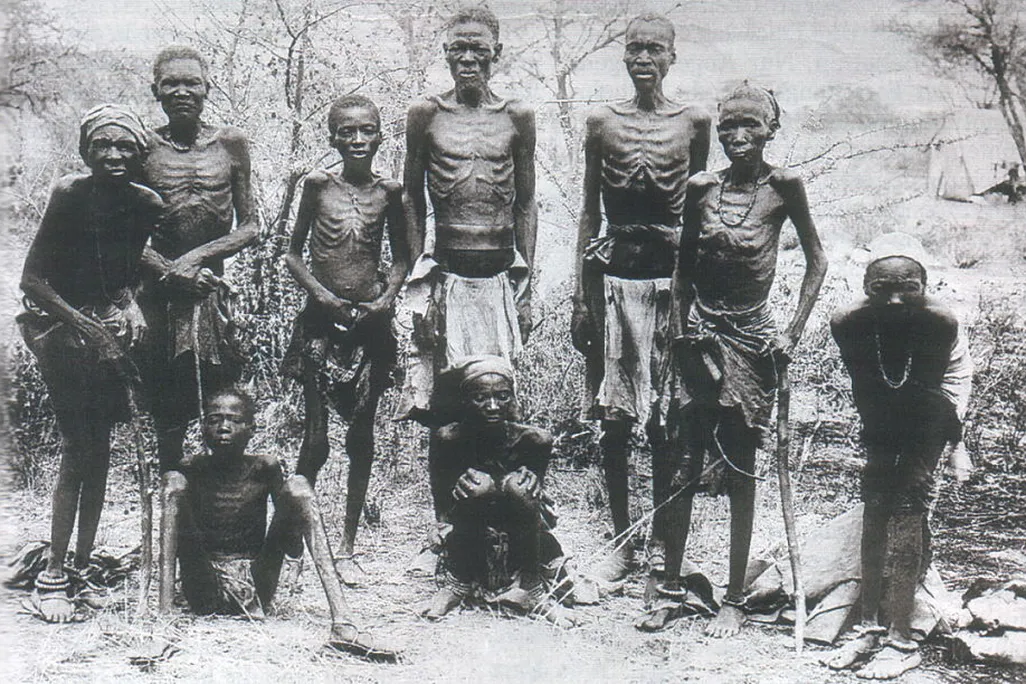
The settler press soon began spinning lurid and exaggerated atrocity stories portraying the Herero as sadistic brutes. In Berlin, the German Chancellor Bernhard von Bülow told parliament that the revolt had erupted “without apparent cause.” The Kaiser postponed a parliamentary inquiry into its origins and fired Leutwein, by then castigated by the German right as a weak appeaser to native savages. His replacement General Lothar von Trotha was a veteran of colonial campaigns in China and avowed white supremacist who believed that dealing with African peoples required overwhelming brutality. On August 11, 1904, Trotha’s troops attacked the bulk of the Herero nation—warriors along with their families and cattle—at the Waterberg plateau. The Herero broke out and fled southeast into the barren Omaheke desert. German patrols sealed off its edges, poisoned existing water sources, and shot anyone who tried to return. Men, women, and children collapsed from exhaustion. On October 2, Trotha’s extermination order formalized what his soldiers were already doing in practice. Having witnessed the brutality of German forces and the fate of the Herero, the Nama under Witbooi then switched sides, waging a guerrilla war against the Germans until 1908.
Unlike in 1862, when hardly any organized political formation within the United States opposed the military response to the Dakota Uprising, the German public in 1904 had more awareness of the atrocities and more of a socialist movement to organize about it. Under pressure from Rhenish missionaries, the German left, and more practical-minded elements of the bureaucracy, Berlin revoked Trotha’s extermination order in December 1904. The German Social Democratic Party (SPD), both its leaders like August Bebel and allied left-wing newspapers (Vorwärts, Der Wahre Jacob, Leipziger Volszeitung) stood out as particularly strong opposition voices during those years. The SPD for instance refused to vote for more military expenditures for the colony in January 1904. As historian Andrew Bonnell writes in Jacobin, Bebel “spoke at length about Germany’s responsibility for the uprising, exposed cases of mistreatment of the African population by the colonial regime, and defended the right of the Herero to fight for their independence.”
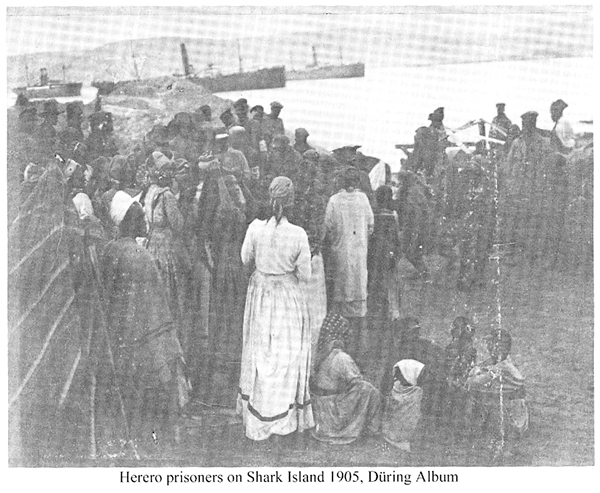
The formal revocation of Trotha’s extermination order notwithstanding, German policy was still quite genocidal. Survivors were rounded up and used as slave labor for railways, harbors, and settler farms. Thousands died in the desert. On Shark Island, Herero and Nama exposed to the cold winds of the Atlantic died of malnutrition, disease, and exhaustion. As a Herero teacher Samuel Kariko later testified to the British:
“Men, women and children were all huddled together. We had no proper clothing, no blankets, and the night air on the sea was bitterly cold. The wet sea fogs drenched us and made our teeth chatter. The people died there like flies that had been poisoned. The great majority died there. The little children and the old people died first, and then the women and the weaker men. No day passed without many deaths. We begged and prayed and appealed for leave to go back to our own country, which is warmer, but the Germans refused. Those men who were fit had to work during the day in the harbour and railway depots. The younger women were selected by the soldiers and taken to their camps as concubines.”
Women were also forced to scrape the skin off the skulls of the corpses and boil them so they could be shipped to universities for German race science research. By 1908, about 65,000 out of 80,000 Herero had been killed, along with 10,000 of the 20,000 Nama. Native lands and cattle were confiscated and redistributed to the settlers, and a 1907 native ordinance barred Herero from owning livestock. For years, survivors of the genocide were required to carry metal pass tokens as a marker of their rebellious status.
Like Minnesota, weak attempts at apology have been made in recent years. The German government formally apologized for the genocide in 2021 and pledged €1.1 billion in development aid to Namibia over thirty years. But this was not reparations to the descendants, and many Herero and Nama leaders reject the terms of the acknowledgement given that it was negotiated without them. Land ownership in Namibia remains highly unequal, dominated by a few German rancher families who mostly live in the capital or abroad.
Gaza Genocide
The timeline of the Al-Aqsa Flood attack by Hamas and other Palestinian armed groups in Gaza on October 7, 2023 has by now become well-known. Their initial target was Israeli towns and military bases within the ‘Gaza envelope’ region bordering the besieged Gaza Strip. Within the four days it took for Israeli forces to retake the border, about 739 Israeli civilians, 379 Israeli soldiers, and 71 foreigners were killed, many in chaotic massacres like the Nova festival. Among the Israeli civilians killed were 70 Arab Muslims. Tens of thousands of Israelis fled the envelope region. Reports vary on how many Israelis were killed by ‘friendly fire’ or the Hannibal directive (an order to prevent the capture of Israeli soldiers by killing them while in enemy custody) but include at least 14 Israelis. About 251 people, both soldiers and civilians, were initially taken captive back into Gaza. By November 2023, 42% of the captives have been released, including a large share of the civilians and foreigners. On the Hamas-led side, about 1,200 fighters were killed and 149 taken captive from Oct 7-11th.
According to the Palestinian analyst Muhammad Shehada, the Al-Aqsa Flood attack consisted of two waves: the first by elite Hamas commandos—the Nukhba forces—mostly focused on Israeli military bases. A second wave by other armed factions and non-Nukhba Hamas elements, as well as petty criminals and spectators, formed spontaneously once news of the attack broke. In Shehada’s analysis, “anyone with a gun rushed to the fence.” They lacked central command, coordination, or set goals, and Hamas leader Yahya Sinwar acknowledged that “things went out of control.” In Hamas’ own ‘Our Narrative’ letter, as well as the opening speech of Mohammed Deif on October 7, the operation was driven by the need to break the suffocating, decades-long siege on Gaza; rescue the thousands of Palestinian prisoners held without trial or otherwise suffering extreme abuse in Israeli prisons; defend Jerusalem and its Al-Aqsa Mosque from increasing Zionist advances, and challenge the global abandonment of Palestinians in the face of Israeli settler colonialism, apartheid, and ethnic cleansing, carried out with near-total impunity since the Nakba of 1948.
Israel’s response, as is now well-recognized, has been to accelerate its contemporaneous, ‘slow-moving’ Nakba into a genocide. Israeli forces have directly killed at least 74,000 Palestinians in the Gaza Strip since 2023 and maimed or injured about twice as many. Phone surveys and analysis of Facebook obituaries by scholars indicate that the counts reported by Gaza’s Ministry of Health has underestimated violent deaths by 40%. Hundreds of thousands more were killed indirectly through siege and starvation policies, as the blockade was ratcheted to levels that left children and the elderly emaciated, skin on bones. Israeli forces have methodically destroyed more than 90% of built structures in Gaza—including hospitals, schools, mosques, churches, apartment buildings, and water treatment plants. For years, the stream of horrors committed by Israel and its American patrons have filled our phone screens—death marches, mass graves, executions by drones and machine guns, the bloodied corpses of children pulled out of rubble without skulls, videos of torture and gang-rape of Palestinians in Israeli prison camps. The genocide has even given us a new acronym WCNSF: “wounded child, no surviving family.”
Today, millions in Gaza are homeless and traumatized—their camps ravaged by rats, mosquitos, dysentery and cholera—under routine bombings and the mind-numbing tinnitus of Israeli surveillance aircraft. In the occupied West Bank and East Jerusalem, settler violence has risen. Israeli outposts and settlements have expanded, as the Israeli government routinely announces new subsidies and building projects for them. In the West Bank, Israeli bulldozers demolish Palestinian homes; Israeli soldiers raid family homes at night and carry off their kin as negotiating leverage; Palestinian communities like Masafer Yatta are expelled by both settlers and the army. The destruction has bled into South Lebanon, where Israel in its war against Hezbollah has flattened 48 of the 60 towns within its occupied territory according to a recent New York Times estimate—an ethnic cleansing of Shia Muslims. Even Palestinians who rescued Israelis on October 7 have had property bulldozed by the army. Over the past three years, those of us at MIT have catalogued these crimes and detailed our own campus institution’s involvement in them.
Compared to the Dakota and Herero uprisings, Gaza’s trauma obviously bears some unique markers. As a 21st century event, the October 7 attack—with its paragliders, automatic weapons, rockets, and go-pro cameras—was a more technologically sophisticated operation than anything a 19th or early 20th century indigenous guerilla movement could have pulled off. This technological edge also made it more deadly. Unlike the Herero or Dakota, Hamas is not primarily a tribal formation; it is a programmatic party with an armed wing, born from the Gaza branch of the Muslim Brotherhood, which commands support across Palestinian family clans. The Gaza Strip itself is also far more densely populated, urbanized, educated, and digitally networked than anything that existed on the Dakota reservations of 1862 or Hereroland of 1904. This has ensured that the Gaza Genocide is recorded in far more graphic and globally visible terms than previous genocides.
Secondly, unlike the Christian Dakota and Herero leaders, who at least had missionaries that could advocate in paternalistic terms on their behalf to the co-religionist settler population, the overwhelmingly Muslim Palestinians in Gaza have no such path of appeal in the Israeli Jewish conscience or the American Christian one. The Zionist-Palestinian cleavage is fundamentally a settler-native divide but also a religious one. One imagines the trajectory of conflict would unfold quite differently if Yahya Sinwar or Yasser Arafat could have claimed a Jewish identity or had linkages to Jewish or Christian faith leaders in the United States. Across the Americas and even in German-ruled Africa, ‘softer’ forms of incorporation—through Christianization, intermarriage, and forced assimilation—had always been an option to eliminate native American societies over time and were often preferred by elites. Assimilation became especially easy for elites to countenance when the settlers vastly outnumbered the natives in population. But in modern Jewish Zionism, mass conversion of Palestinian Arabs was never seriously entertained as a means to solve the ‘native question.’ Had it been tried, it would probably not have succeeded among Palestinians to the same extent Christianization succeeded among native Americans.
A final difference is perhaps the peculiar role of Jewish fear and trauma in the Israeli Zionist political culture—arguably unique among settler societies. The 19th century Swedish and American settlers in Minnesota or German settlers in Africa did not draw on the same emotionally-loaded, national mythmaking of victimhood that Israelis do today, constantly reinforced by the Zionist version of Holocaust remembrance. This has arguably reinforced the enduring callousness and revenge hysteria of Israeli society, beyond what it would be otherwise.
As Americans, or at least as students at an American university, the only practical difference between what Americans did during the Dakota Uprising and what we do in Gaza today by arming Israel is that Gaza is not in the past. There is still time to intervene to stop the mass murder and ethnic cleansing of Palestinians. Young democratic socialists can even take inspiration from August Bebel and the early SPD as an example of what principled opposition to colonialism from the metropole can look like. If you do not know how to intervene or organize effectively, the YDSA and the MIT Coalition for Palestine are a good place to look. The national DSA for example recently launched its Arms Embargo campaign to stop the flow of weapons to Israel through U.S. airports. By now we all should have a clear sense of what philanthropic, electoral, labor, and social movement levers we need to use in order to register the greatest impact. The only question is: will we use them?